In an industry known more for bricks than pixels, Suffolk recognized a need to innovate in the early 2000s, investing heavily in data and technology to drive productivity and efficiency and support complex projects.
For five years now, a handful of Suffolk employees have participated in conjunction with the ACE mentor program, which runs during the school year. The ACE Mentorship Program of America, which Suffolk sponsors, aims to expose, engage and encourage high school students to pursue careers in architecture, construction or engineering through mentoring and ongoing support and to promote their advancement in their chosen industry.
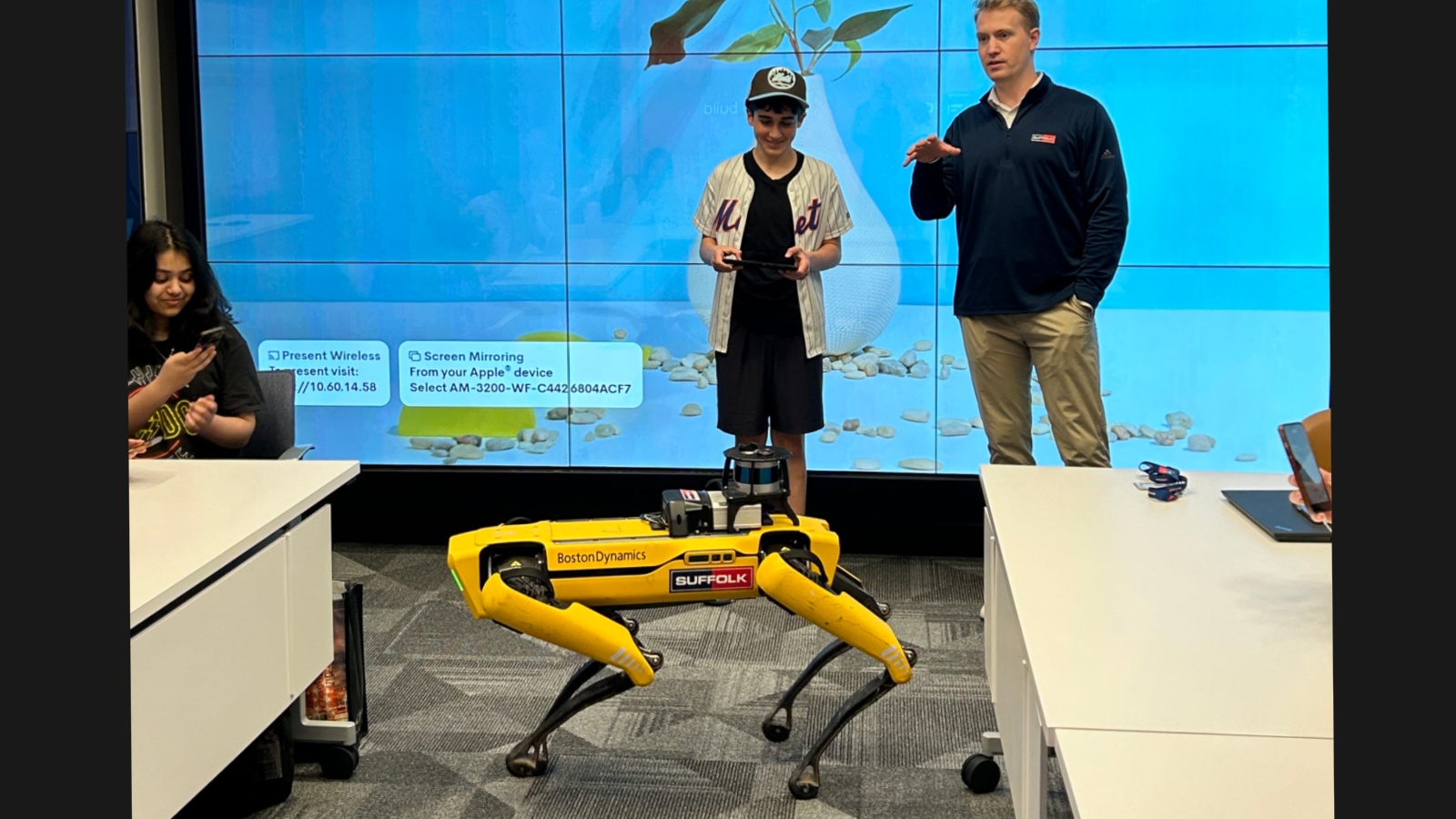
Katherine Maloney, director of corporate giving at Suffolk, says, “We work with the students on a weekly or biweekly basis, teaching them backgrounds of architecture, construction and engineering, and then they complete a pseudo-design/build project.” The students this year opted to design a Japanese restaurant in outer space. Maloney says the far-out choice was inspired by a May 1 visit between ACE students and Suffolk’s latest hire—Spot the robot dog.
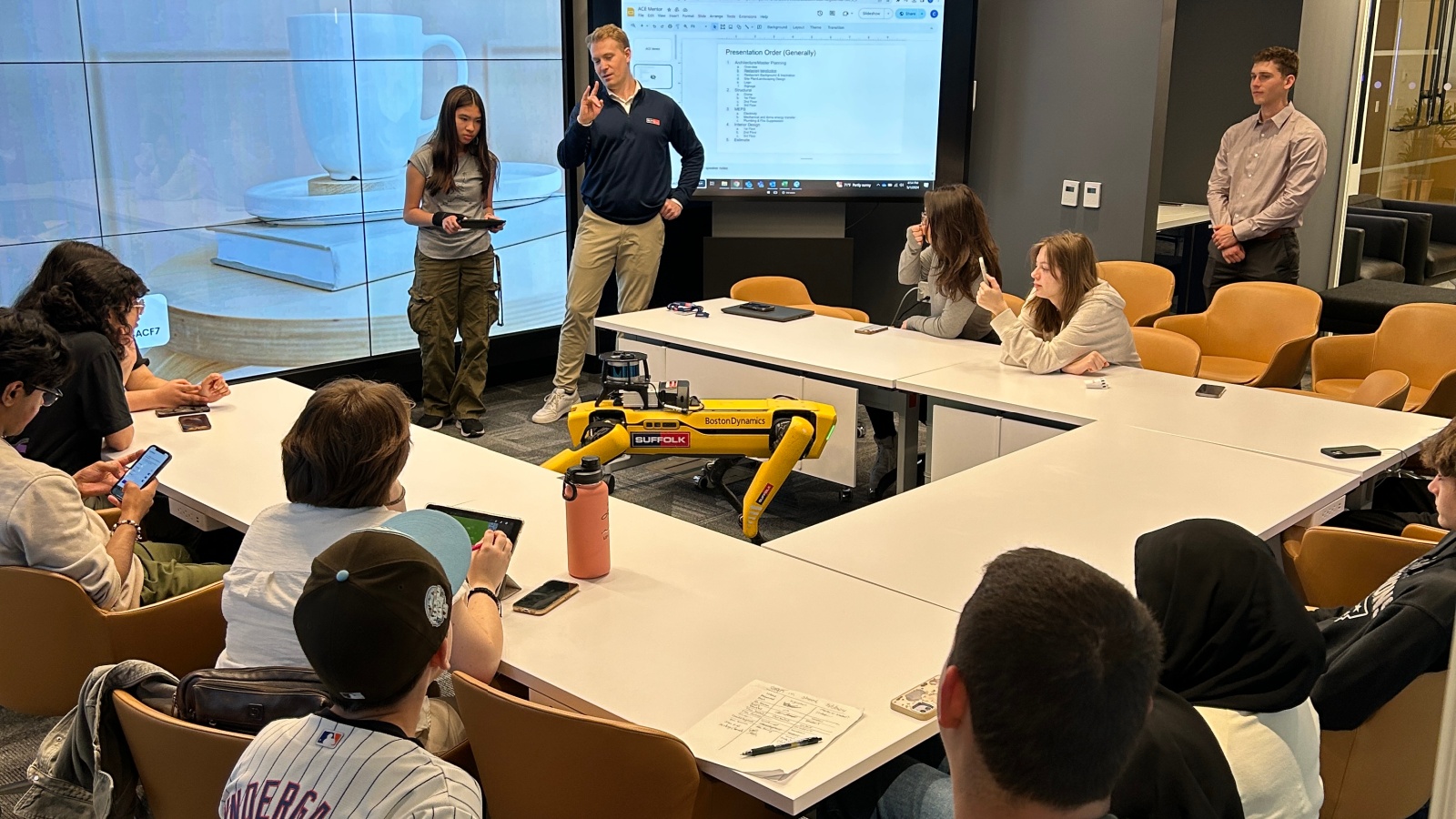
Suffolk’s toolbox includes many advanced tech tools used by the industry, and Spot was one of the tools demonstrated at this recent spring ACE meeting. “We were able to really give them a background on how we use technology on our jobsites and why [technology is] important to us as we think about the future of construction,” says Maloney.
WIN-WIN MENTORSHIP
ACE Mentor is a national program with chapters throughout the country, and as Suffolk has been involved with the program in New York for years, more of its members are expressing interest in participating, too—including those in Boston, Los Angeles and San Francisco. This program not only exposes students to industry experts and lifelike robots, but it exposes those already employed in the industry to the future of the workforce—and perhaps to some fresh perspective.
“Our employees are super engaged,” says Maloney. “They really love giving back to the students. And I think what’s unique about ACE is it’s really a long-term engagement. So, you get to see those same students week after week and really get to develop relationships with them and see how they’re progressing through school, how their interests change, how they change from the kid who wouldn’t speak in October to the kid who won’t stop talking in the meetings in May.”
That level of engagement is not lost on the students, many of whom Maloney sees return from freshman year through graduation to starting their career paths. It is not lost on Suffolk’s employees either. As more become involved with ACE Mentor across Suffolk’s national network, the program is having a positive impact on their career paths as well.
Maloney mentions that as she sees her employees become more involved with ACE, as well as other community engagement opportunities, “they’re more excited, they’re more engaged in general.”
Suffolk’s community involvement has been able to help students and employees alike from a professional development perspective. Current and seasoned employees are becoming a part of the mentor and fundraising committees, increasing retention, while these points are attractive for recruiting new employees.
DROP IN THE BUCKET
Maloney knows it is important to show the ways the company engages within itself and its greater community. “You’re not one drop in the bucket,” she says. Suffolk truly sets these students up to succeed and remembers them when they do.
She recalls one student who participated in the ACE Mentor program for a few years in a row, then graduated with an interest in structural engineering. “That student really bonded with one of our senior PMs here and they’ve stayed in contact as he’s entering his post-high-school career. So it is something that we’re trying to figure out—what is next and how do we keep in contact with all of them.” In some cases, those students are welcomed back to Suffolk as employees. “That’s kind of the whole point,” says Maloney. “It’s important to participate in these community programs, but how do we make sure there’s a sustained relationship after the program, as well?”
SPOT ON
Of the students who participated in Suffolk’s visit with Spot on May 1, some will go on to graduate, others will begin to think about honing their interests as seniors and others are just beginning their high-school careers—but what all of the will have in common after this day are the memories made.
“You’re not necessarily used to a robot dog walking down the hallway of an office. So, it’s always funny to see [the students] at that moment. There’s always a little freak-out moment at the beginning, but then it is just pure excitement and wonderment of, ‘Is this the future? How do we all get one of these? How do you use this?’ It’s something that I think they’ve never seen before, and they really were just truly wide-eyed.”
The experiences students in the ACE Mentor program obtain at Suffolk ingrain in them the importance of and opportunities within the skilled trades, and just as with early childhood development, hands-on, visceral experience is key to career development—whether that be for a student just starting out in their career or a mentor furthering it.